Full story by Weather.com: Historic Storm Carolinas to Mid-Atlantic
After passing through the south east, the storm hitting the mide-atlanitc states of New Jersey and Delaware today will sweap into the Southern New England States of Connecticut and Rhode Island late tomorrow (11/13/09) afternoon.
Coastal flooding in addition to the 2-4" of rain fall is being forcast by many local news channels.
Need help with flood water or moisture in the basement during the storm?
Maryland, DC and Arlington VA - Floodbusters Basement Waterproofing
Richmond, Norfolk, Alexandria, and Hampton - Virginia Basement Waterproofing
Connecticut and Southern New York - Charter Oak Enviromental
Eastern CT, Rhode Island and Massachusetts - Pioneer Basement Waterproofing
Read about the Top 6 Basement Mistakes that contractors and homeowners make.
Ask Jacob A question Directly on Pioneer Basement's Help Forums!
11/12/2009


11/10/2009
Turning the Heat on in winter will show you the actual air quality of your Basement
How would turning the heat on upstairs have anything to do with the air quality of basement? It’s an interesting concept, but it’s one that many air quality experts, including Craig Clark from Ocean State Air in Rhode Island, deals with every winter.
We all know that the condition of the basement affects the air quality in the rest of the home. Lingering water, moisture and water damage, mold or other pollutants in the basement can influence the quality of the air and aggravate sensitivities in the homeowners.
Moisture problems that go unchecked in the summer don’t feel as serious in the winter. The cold air, for the most part, masks the issues in the basement. Humidity and excess moisture build up are as tangible in the winter as they are in the summer months that are naturally humid.
This becomes the combination to cause issues.
Turning on the heat forces warm air through your home, and in many cases your basement as well. This can awaken any unaddressed moisture issues again in the winter. With warm moist air now back again in the basement during winter, people with respiratory issues can be affected again when they least expect it.
“It’s not uncommon for an entire house to get sick because of poor air quality issues in the winter that could have been avoided by addressing them in the summer,” says Craig Clark, president of Ocean State Air in Rhode Island.
“Correcting an air quality issue in the home can avoid complications in months where normally there isn’t a problem.
“If you maintain the Relative Humidity, you can control the dew point and prevent the mold growth on cold surface areas.
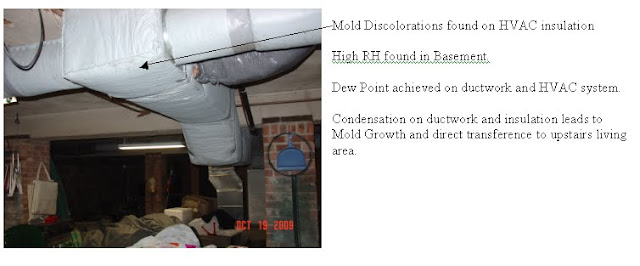
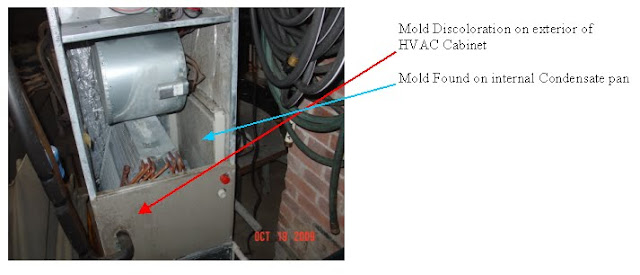
“When homeowners turn the heating system on for the first time with mold contamination inside the HVAC system, the dried up mold becomes aerolized and can cause substantial discomfort to persons with mold allergies. A non-viable mold spore or mold fragment can cause as much discomfort as a viable spore or fragment.”
The World Heath Organization back in August finally announced its findings about increased illness in buildings with air quality issues. Occupants of a building with moisture issues are 70% more likely to become ill than occupants of buildings with proper air quality.
Like always, make sure to have your home inspected to make sure that you don’t have moisture or a mold issue. With this new pattern in New England it might be a good idea to have an inspection before cranking the heat this winter.
Read about the Top 6 Basement Mistakes that contractors and homeowners make.
We all know that the condition of the basement affects the air quality in the rest of the home. Lingering water, moisture and water damage, mold or other pollutants in the basement can influence the quality of the air and aggravate sensitivities in the homeowners.
Moisture problems that go unchecked in the summer don’t feel as serious in the winter. The cold air, for the most part, masks the issues in the basement. Humidity and excess moisture build up are as tangible in the winter as they are in the summer months that are naturally humid.
This becomes the combination to cause issues.
Turning on the heat forces warm air through your home, and in many cases your basement as well. This can awaken any unaddressed moisture issues again in the winter. With warm moist air now back again in the basement during winter, people with respiratory issues can be affected again when they least expect it.
“It’s not uncommon for an entire house to get sick because of poor air quality issues in the winter that could have been avoided by addressing them in the summer,” says Craig Clark, president of Ocean State Air in Rhode Island.
“Correcting an air quality issue in the home can avoid complications in months where normally there isn’t a problem.
“If you maintain the Relative Humidity, you can control the dew point and prevent the mold growth on cold surface areas.

“When homeowners turn the heating system on for the first time with mold contamination inside the HVAC system, the dried up mold becomes aerolized and can cause substantial discomfort to persons with mold allergies. A non-viable mold spore or mold fragment can cause as much discomfort as a viable spore or fragment.”

The World Heath Organization back in August finally announced its findings about increased illness in buildings with air quality issues. Occupants of a building with moisture issues are 70% more likely to become ill than occupants of buildings with proper air quality.
Like always, make sure to have your home inspected to make sure that you don’t have moisture or a mold issue. With this new pattern in New England it might be a good idea to have an inspection before cranking the heat this winter.
Read about the Top 6 Basement Mistakes that contractors and homeowners make.
11/06/2009
Basement Mistake pt 6 – Not Testing for Radon Gas every 2 Years.

The EPA has responded by urging US citizens to test for radon in basements and crawlspaces every 2 years. This gives enough time between tests for dramatic changes created by remediation and other control systems in a basement or crawlspace to take hold.
So why haven’t you tested yet?
Not testing for Radon is pretty normal. Many homeowners and contractors, even with the Press and Media buzz about radon in marble table tops this past year, still haven’t seen the need to test. Only recently have large home improvement stores like Home Depot and Lowe’s started carrying the DIY Radon Test kits.
Let me put it this way: If you could avoid a dodge-ball to the face by simply moving a few inches…would you?
Testing is easy, cheep and accurate
DIY Test kits are provided by basement waterproofing companies, Radon Mitigation companies and even big box stores. Tests normally range from a few dollars to around $50 for full on-professional grade testing.
Many DIY Radon test results are generated by third-party testing labs, which is not only good for the company providing the test, (you also know that skilled professional Radon testing experts are providing quick and accurate results that are not swayed by the person who gave you the test) but its also good for YOU (the homeowner.)
So in this example the dodge ball is Radon while “moving” is simply spending a few dollars.
The difference is that Radon can kill you and a dodge-ball cannot. Unless the dodge-ball has spikes, in which case that is not a regulation style ball and shouldn’t be used. (Safety first)
Not testing for Radon in a basement or crawlspace is definitely one of the Top 6 BIGGEST and most common basement mistakes that homeowners and contractors alike make.
Related Links and Sites
EPA's home buyer's and Seller's Guide to Radon
11/05/2009
Basement Mistakes pt 5 – Finishing a Basement with Organic Construction Materials

I’ve spoken on the topic of organic material vs. in-organic material in the basement several times on multiple forums and in this blog. Renewable resource material isn’t always the same as Organic Material. Many Renewable construction materials are made out of recycled plastics and metals – which (lucky for you) are both In-Organic!!!
Green Home Improvement and the Basement Health Industry live in harmony once more!
Organic materials in a basement
One of the largest concerns about many homeowners is mold. Mold requires moisture, a dark space, and food to eat. Mold is able to break down organic materials like wood and paper; this is what it uses as food. Any wood, paper, paper-products, fabric, cardboard or dry wall can potentially become mold food.
Moisture Resistant materials and In-Organic Construction
The basement environment is radically different because of its naturally increased levels of humidity. This makes it that much more important to build with materials that are designed for moist areas and that don’t provide a food source for mold spores.
Paperless insulation, paperless dry wall, metal studs, and other materials are what are needed to properly finish a space in the basement. These materials, depending on their manufacturer, possess qualities that allow them to withstand moisture, provide rigid and custom fabrication, and possess all the same qualities of the construction materials used on the 1st and 2nd floors.
Placement of the studs.
Many homes, especially around New England, have finished basements. Homeowners and contractors for decades have been installing the wood studs directly against the foundation wall. A.) This is lazy and B.) This causes problems.
Lazy:
By putting a stud against the foundation wall you’re hoping that the foundation is plum and it’s one less step to do. Who needs to make sure anything’s level right? (Cough*sarcasm*cough)
Causes Problems:
Moisture travels through the foundation wall and comes into contact with these wood studs. Mold spores LOVE this and thrive, OR dry rot occurs, eventually rendering the wall useless.
Placing studs 2”-4” away from any foundation wall gives enough room to force air circulation and filtration behind the walls which keeps the area moving and clear of mold and excess moisture.
The area behind the studs is vulnerable to excess moisture build up, even more so then the rest of the basement, so if there is insulation in the finished walls, it’s that much more important to provide circulation and dehumidification.
The Take Away:
1.) DON’T USE WOOD STUDS!
2.) DON’T USE “Standard” Dry wall!
3.) DON’T USE PAPER BACKED INSULATION
4.) USE MATERIALS THAT HAVE BEEN TESTED TO BE MOISTURE AND MILDEW RESISTANT –many of these also have excellent fire ratings
5.) IF you don’t know what to do: ASK A PROFESSIONAL!
Hundreds of Thousands of dollars a year are wasted in ill-prepared and poorly planned basement finishing designs using the WRONG material. This is why it falls, yet again, under the Top 6 Most Common Basement Mistakes that homeowners and contractors make.
11/04/2009
Basement Mistake pt 4 – Having Open sump pits or drainage systems.

The good news is that these two out-dated technologies are easily replaceable and easy to update.
Open sump pits – What’s the deal?
Having a sump pump installed is a good plan to deal with excess moisture and liquid water underneath the basement floor. It’s an excellent way to deal with water build up and hydrostatic pressure. A sump pump is designed to be fully under water, and when the water level is high enough it pumps the water out.
Now, when the water level is too low to activate the pump it can rest at the bottom of the sump basin. Many older designs of these basins didn’t come with lids. Homeowners created wood, metal and plastic sheets to cover the hole, but these do not seal the area off from the basement. Even with having a sump pump dealing with the water under the floor, homeowners would still be introducing the moisture from the standing water in the basin into the basement’s air. This can still happen and can lead to mold and moisture issues as well as give a direct path for water to jump the system. Flooding and other unpleasant things can also occur from having an open sump liner. (This doesn’t include the safety reasons – people falling in, toys or objects clogging and breaking pumps, rodents, insects, iron bacteria.etc.)
Open and open back drainage systems
For a long time, open back drainage systems were the cutting edge of technology. Combining the ideas of pipe and stone systems with the conveniences of easy installation on the footer and the simple method of collecting water from the walls. With water dripping or running down the walls from a floor crack, these open back systems would simply collect the water and put it in the drain.
 Everything was well-and-good in the Basement Waterproofing Industry until people realized that these open systems were in fact allowing moisture and water to jump the system. The moisture that would build up in a system that was level (not allowing for continuous flow in a gravity fed direction) would also evaporate and escape out the back, thus adding humidity and moisture problems back into the basement.
 Without knowing any better thousands of homes across America, especially in New England have increased the problems in their basements with these “easy install” fixes.
Many DIYers, and even seasoned Contractors, unknowingly subjected their (and their clients) basements to sump pump pits that were:
1.) Too Deep, causing undermining to the foundation
2.) Open allowing moisture to cause more problems in the basement
3.) Allowing water to have the ability to flood the basement or crawlspace from the sump
4.) Allow soil VOCs and other pollutants to enter the air in the home.
Having an open sump pit or an open back system installed is actually providing you with the opposite of what you’d hope. They allow moisture to collect and expand into the basement or crawl space while providing minimum protection to the home for floods and excess water. Because of these reasons, and several safety reasons, is why this falls under one of the Top 6 Basement Mistakes that could cost you money in repairs and damage.
Subscribe to:
Posts (Atom)

 Posts
Posts


